
Friday, 10 May 2013
Mosquitoes even prey on the iguanas
On my walk home from dinner last night I stumbled across a marine iguana that had managed to find itself a warm secluded hiding spot. It was quite interesting to find so many mosquitoes targeting it while ignoring me. Neat but sad to think of ectotherm specialist mosquitoes.

Thursday, 9 May 2013
Long distance travellers
Just when you think that every animal down here is new to you, you then discover a familiar friend, the Great Blue Heron. So apparently they are pretty widespread, as we have them in Canada. Funny though….this one let me get quite close whereas those I see in Canada are skittish. Funny how fear of humans is learned. I'd be scared of us at the first sight myself.

Wednesday, 8 May 2013
Are we studying them, or are they studying us?
I always feel like I am being watched here in Galapagos. Not the authorities who seem to keep a tight lid on anything, but the animals. Given that most have no or little fear of humans, they are quite approachable. However, even when you are in the field doing something, you feel like the wildlife is watching you. Chances are, something is sitting in a tree or bush looking down at you with little apparent desire to flee.
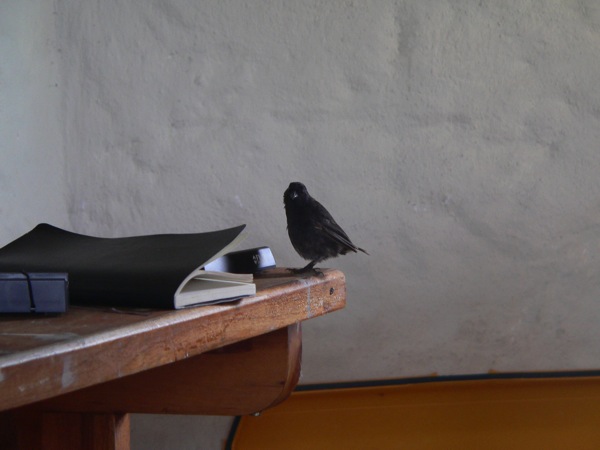
Case in point, here is a small ground finch that has flown into my room and is perched beside my journal. Maybe he wants to add a note? Perhaps something whispered to him by other scientists?
Monday, 6 May 2013
Some like it hot...
In theory, I could post a complete thermal image library of Galapagos fauna, but I'm saving that for my big 'coffee table thermal image book' that will make me millions. Meanwhile, here are a few crabs basking/avoiding the sun.
What I find incredible here is how fast things heat up in the sun. These crabs were moving quite a lot, yet you still see how the little bit of shade offered along a rock wall affords them the ability to alter temperature quickly.
You heard it here…anytime someone says that ectotherms/cold blooded animals simply conform to the temperature of their environment you can tell them 'nope'!
Bask away crustaceans. Those of you who like to eat crabs are probably salivating right now.

Saturday, 4 May 2013
Giant tortoises - cows of the Galapagos
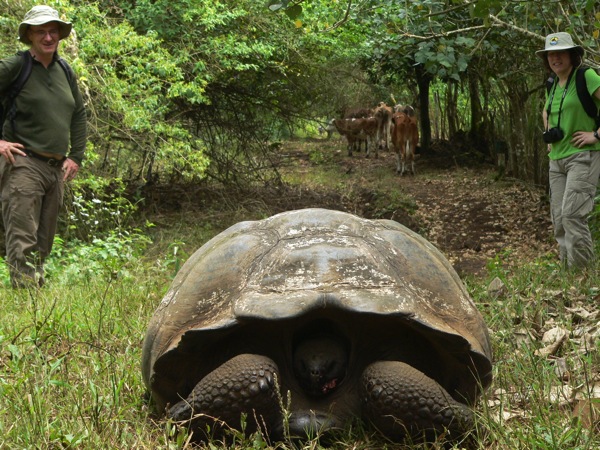
I was invited to accompany the giant tortoise research group to track some of their tortoises in the highlands here on Santa Cruz. We found "Sir David Attenborough", a tortoise named after the inimitable narrator of all life on earth…
Anyhow, it's amazing to think that before humans exploited the Galapagos, there were an estimated 300,000 tortoises on the entire island archipeligo. Not often you think of an ectotherm as the predominant grazer in the landscape. Modern day cows (see the background) are common on the inhabited islands as sources of food and milk for people who live here, but on Santa Cruz island, the native tortoise population has rebounded to ~5000 individuals (10 of whom we came across the other day during our hike through the highlands.
Years ago, goats were introduced and became resident and wild and were responsible for outcompeting the tortoises on numerous islands in the Galapagos. The goat eradication program seems to have been a success. So much so that nearly every taxi driver we meet has had a prior job working as a goat eradicator. I presume if it was still lucrative business they would not be driving cabs.
Years ago, goats were introduced and became resident and wild and were responsible for outcompeting the tortoises on numerous islands in the Galapagos. The goat eradication program seems to have been a success. So much so that nearly every taxi driver we meet has had a prior job working as a goat eradicator. I presume if it was still lucrative business they would not be driving cabs.
Friday, 3 May 2013
Side experiments on plants?
I've been watching closely a bunch of bananas in our room with the thermal camera, and notice a little bit of heat production:

Heat from the ripening process? This little side project was going well until one of my room mates started to eat my experimental subjects.
Heat from the ripening process? This little side project was going well until one of my room mates started to eat my experimental subjects.
Woodpecker finch!
One of the first woodpecker finches we've seen. This juvenile was quite amusing, as it was following it's mother around begging for food and perhaps learning how to search for insects. He didn't do anything impressive with sticks or tools, sadly.

His mother, on the other hand, was quite a busy bird, and at one stage appeared to be using a piece of twine for something (not just nest material gathering) - as she would pull this twine with her bill, then hold it in her claw and further pull on it with her bill. Quite determined. Anyhow, here she is feasting on a caterpillar she just happened upon. Looks like she is only eating the guts:
His mother, on the other hand, was quite a busy bird, and at one stage appeared to be using a piece of twine for something (not just nest material gathering) - as she would pull this twine with her bill, then hold it in her claw and further pull on it with her bill. Quite determined. Anyhow, here she is feasting on a caterpillar she just happened upon. Looks like she is only eating the guts:
Subscribe to:
Posts (Atom)