Wednesday, 31 July 2013

Long time, no post - A tribute to my Avian Colleagues

It's been a while since I've posted on here. Somehow it is easier to come up with ideas to blog about when you are on a tropical island surrounded by wonderful flora and fauna. I am sitting in my office back at Brock University watching the hummingbird make regular visits to the feeder located inches from my head.
2012 06 13T145209203
However, I want to use this opportunity to acknowledge some significant developments in my new found interest in avian physiology. Let this be an example of the funner aspects of science and the rewards of serendipitous research interests. I'll post this as a chronology here, but the reality is that this research has resulted from being allowed an unfettered approach to research. I fear that if I had specifically applied to granting agencies to do various aspects of this work, it is doubtful we would have been successful in being funded. Long live curiosity-based science! Of course, now that this curiosity science has helped to answer some questions for me, I am more and more interested in pursuing these questions in a more formal manner, but I won't bore people with those details.

2006-2009: I published a paper on the toco toucan bill's losing significant amounts of body heat. Unplanned, but this generated a bit of publicity and helped me become introduced to some wonderful scientists and colleagues (see below). Thanks to my Brasilian co-authors, Dr. Augusto Abe and Dr. Denis Andrade for introducing me to these wonderful animals and to basically introducing me to this question.

2009: While writing up the paper above, I happened to be in Melbourne, Australia visiting my friend, Dr. Matthew Symonds. As he is more mathematically inclined, I asked him to collaborate on a project examining the evidence in the published literature for Allen's Rule in Bird bills. Remarkably, we found pretty strong evidence for this and published a neat account of this in American Naturalist. Since this paper, I've become more interested in assessing the influence of the environment on morphology and physiology of birds.

2010 - present: Meanwhile, I received an email from Dr. Russell Greenberg at the Smithsonian Institute about bird bills and heat loss and whether temperature might be explaining some of the variation in observations he was making in numerous sparrow species around North America. Russ invited my student, Viviana Cadena to work with him and Ray Danner on this project, which led to a paper showing that two subspecies of song sparrows use their bills differently for heat exchange. Working with Russ and Ray has opened my eyes to the field of evolutionary physiology.

2010 - present: Meanwhile again, I struck up a conversation with my friend and colleague Dr. Gary Burness at Trent University who does much work on avian stress physiological ecology and convinced him to collaborate on a project with his undergraduate, Jacqueline Huard on the potential plasticity of bill growth as a function of temperature in Japanese quail. The fruits of this project were just published in the Proceedings of the Royal Society - B and also just highlighted in Nature. We also discovered that temperature during early life may have long lasting effects into adulthood physiology.

2012 - present: Russ Greenberg suggested we apply to National Geographic Society to carry on our interests in the Galapagos and we were successful. This is also the time I started this blog, inspired by the camaraderie and collaborations of those above. Let's hope I can continue to update this chronology with studies with great people and scientists. I was able to meet Dr. Jaime Chaves and start interacting with evolutionary biologists studying Darwin's Finches.

To wrap this up, it's been a blast. Thanks to all these people above and I hope for many future research opportunities. I wish all research were like this

Thursday, 16 May 2013

Get the rats off the island!

On the night before I was heading off Galapagos, I took the thermal camera outside thinking it might be helpful in finding birds roosting. I wish I had good images to share with you, but although I did see roosting birds, I was more intrigued and disturbed by mammals crawling in the trees. These mammals were invasive rats crawling around the very trees within our finches live. I hasten to wonder whether they were targeting birds or their nests.


(Source: http://www.nature.com/news/invasive-species-the-18-km2-rat-trap-1.12992?WT.mc_id=FBK_NatureNews )

Then, I see this post on Nature News about the Galapagos efforts to get the rats off the islands. I suspect this will be an uphill battle of epic proportions. Let's hope they make some progress.

Sunday, 12 May 2013

My journey in Galapagos is about to end...

Tomorrow morning I head back to Canada, but with a long face. I can hardly say I am looking forward to getting back to work on the mundane paperwork required for university administration, but such is what awaits me. My annual report is due 3 days ago, but I've not had a chance to tick all the boxes justifying my existence. I wonder if my blog counts? We have had a productive research trip here. It may seem odd that I have rarely blogged about our research, but for good reason I felt it appropriate not to talk about the research here, for fear of pre-judging our data or indeed scooping ourselves! Actually, when we received the National Geographic Society grant last November, it came with rules about not keeping a blog about the research and not having a documentary team filming us without NGS approval. I think I've kept pretty well away from blogging about our research here, at least until we publish it. :) As for the documentary team, well, unless one was hiding in the bushes here... Anyhow, my personal thanks go to the employees of the Charles Darwin Research Station who have helped guide us through the permitting process, the Galapagos National Park officials whose responsibility for conserving the Galapagos islands and their flora and fauna is immense, and to Jaime Chaves who helped to train us in finch identification and led us to our field sites. I look forward to seeing you all again next year! Hasta luego, Galapagos.

Saturday, 11 May 2013

He who started it all...

Certainly, Darwin has a heavy presence in the Galapagos. Poor Wallace gets overlooked here more than anywhere. There are Darwin's finches. You can order Darwin's rolls at the sushi restaurant. There is the Charles Darwin Research Station. Little islands are named after the Beagle. You almost get the impression that Darwin spent his entire 5 year voyage in the Galapagos, which is ironic since they probably stopped here to pick up tortoises for meat for their voyage. Anyhow, here is the rather askance looking Charles Darwin in the town of Puerto Ayora. We walk past this statue every day. We have yet to see a portrait of Darwin smiling although apparently one does exist.

IMG 0903

It is ironic that we are investigating the adaptive thermal biology of Darwin's finches, when the finches were not actually high on Darwin's radar. The mockingbirds, on the other hand, Darwin did recognize as separate species on different islands. Wish I had my copy of the Origin with me, as I'd be able to read up on it while I am here.

Friday, 10 May 2013

Mosquitoes even prey on the iguanas

On my walk home from dinner last night I stumbled across a marine iguana that had managed to find itself a warm secluded hiding spot. It was quite interesting to find so many mosquitoes targeting it while ignoring me. Neat but sad to think of ectotherm specialist mosquitoes.

Seq 2430

Thursday, 9 May 2013

Long distance travellers

Just when you think that every animal down here is new to you, you then discover a familiar friend, the Great Blue Heron. So apparently they are pretty widespread, as we have them in Canada. Funny though….this one let me get quite close whereas those I see in Canada are skittish. Funny how fear of humans is learned. I'd be scared of us at the first sight myself.

P1080512

Wednesday, 8 May 2013

Are we studying them, or are they studying us?

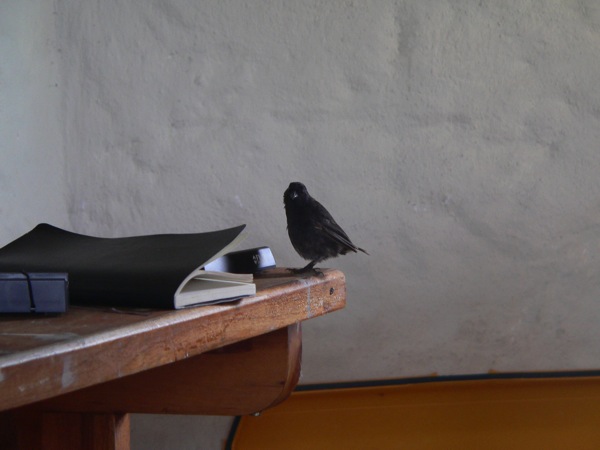
I always feel like I am being watched here in Galapagos. Not the authorities who seem to keep a tight lid on anything, but the animals. Given that most have no or little fear of humans, they are quite approachable. However, even when you are in the field doing something, you feel like the wildlife is watching you. Chances are, something is sitting in a tree or bush looking down at you with little apparent desire to flee. Case in point, here is a small ground finch that has flown into my room and is perched beside my journal. Maybe he wants to add a note? Perhaps something whispered to him by other scientists?


P1100207